
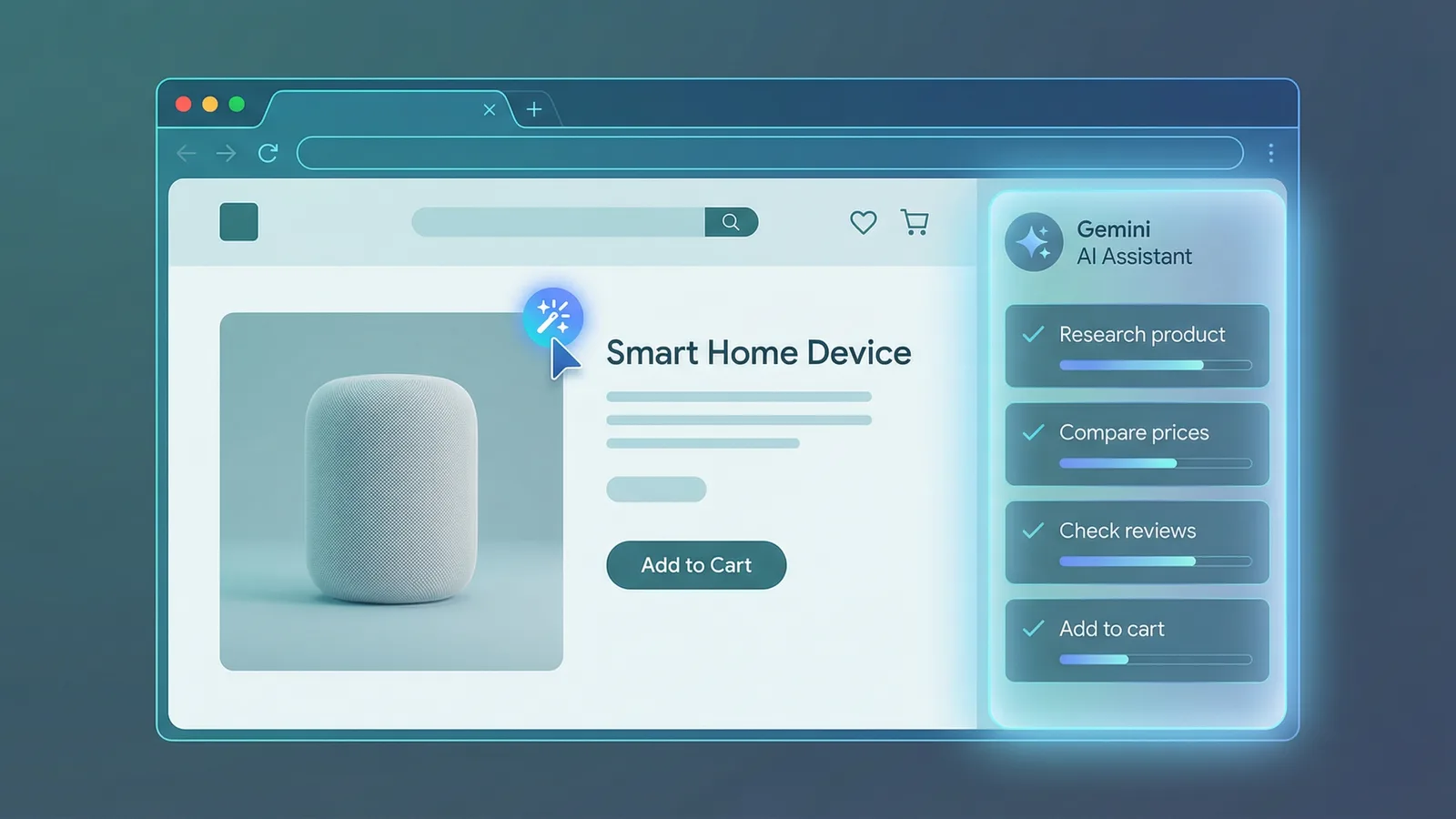
Google on 28 January 2026 launched auto-browse in Chrome, an AI agent powered by Gemini 3 that can navigate websites, fill forms, compare prices, and complete purchases on behalf of users. Chrome VP Parisa Tabriz demonstrated the feature during a live event, ordering a jacket while continuing her presentation. The AI logged in via Google Password Manager, found the item, added it to the cart, and completed the purchase without her touching the keyboard.
This is not a chatbot bolted onto a browser. Auto-browse operates directly on web pages as users see them. It interprets the DOM, recognises forms, buttons, and navigation elements, constructs task plans, and adapts when something unexpected happens. For UK businesses, the question is simple: when an AI agent visits your website instead of a human, will it be able to complete the task?
Auto-browse is currently US-only and requires a Google AI Pro subscription ($19.99/month) or AI Ultra ($249.99/month). But with Chrome commanding over 65% of global browser share across 3+ billion users, the direction is clear.
What Auto-Browse Actually Does
Users describe a task in natural language through the Gemini side panel on the right side of Chrome. Auto-browse opens a new tab, shows a glowing border to indicate the AI is working, and displays every action it takes in the side panel. Users can inspect each step and take over at any point.
The range of tasks is broader than most coverage suggests. Google's demonstrations included shopping and price comparison, but auto-browse also handles travel research across multiple date options, appointment scheduling, tax document collection, bill payment verification, expense report management, and service quote gathering. Tabriz described the target use case as "digital laundry": the repetitive multi-step web tasks that consume time but require no creative thought.
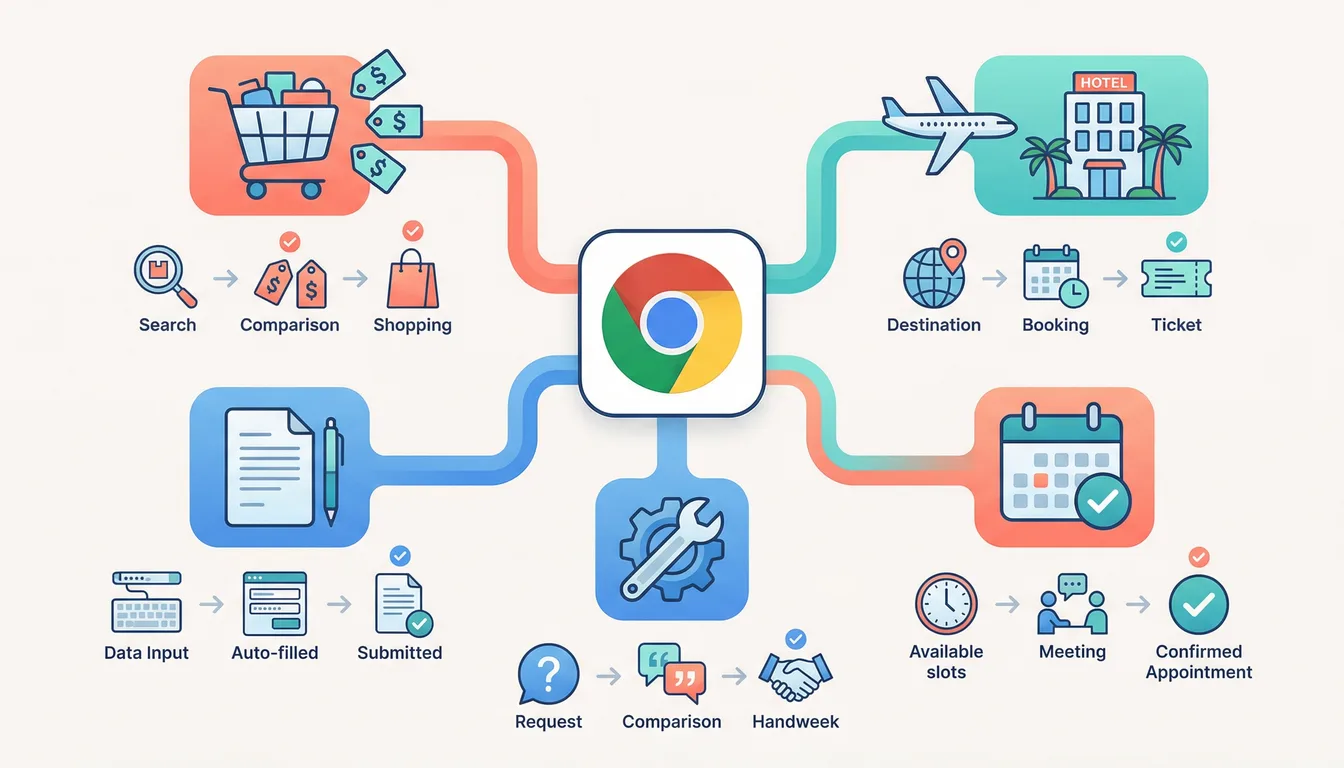
For e-commerce, the implications are immediate. An AI agent does not browse a catalogue, admire product photography, or respond to urgency messaging. It compares specifications, checks prices, applies discount codes, and completes the transaction. The emotional design triggers that drive impulse purchases lose their effectiveness when an algorithm is making the decisions.
The Security Architecture
Google built a four-layer security model around auto-browse, which is notable given that research from the WASP paper found that attacks partially succeed in up to 86% of cases against current AI agents.
The centrepiece is the User Alignment Critic, a separate Gemini model that runs in isolation from untrusted web content. This second model independently evaluates every action the primary agent wants to take. If an action looks risky or irrelevant to the user's stated goal, it orders a retry or hands control back to the user. Because the critic is isolated, it cannot be compromised by prompt injection attacks embedded in web pages.
Three additional layers reinforce the critic. Agent Origin Sets extend Chrome's site isolation to limit what data the agent can access. Prompt injection detection runs in parallel to block actions triggered by malicious page content. User confirmations require explicit approval before the agent signs into accounts, completes purchases, navigates to banking or healthcare sites, or posts on social media.
The agent cannot download files or run code. Google is paying up to $20,000 through its bug bounty programme for demonstrated breaches. Automated red-teaming systems generate malicious sandboxed sites to stress-test the defences, with priority given to scenarios involving credential leaks and unwanted financial transactions.
Universal Commerce Protocol: The Infrastructure Behind Agent Shopping
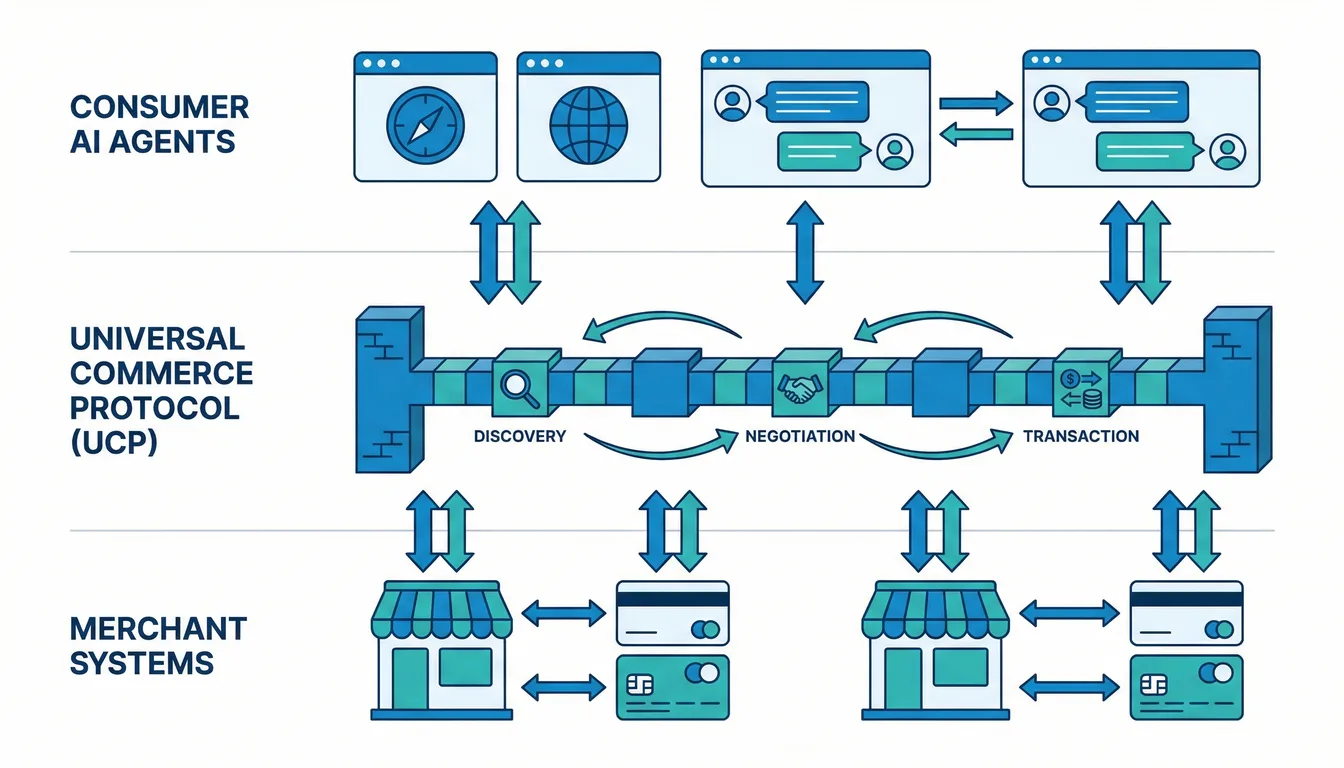
Auto-browse navigates websites the way a human would. But Google is also building a more structured path for agent-to-merchant interaction. The Universal Commerce Protocol (UCP), announced on 11 January at the National Retail Federation conference, is an open-source standard co-developed with Shopify, Etsy, Wayfair, Target, and Walmart.
UCP defines how AI agents discover what a merchant offers, negotiate capabilities, and complete transactions. It integrates with Agent2Agent (A2A) protocol and Model Context Protocol (MCP) for interoperability. Over 20 partners have endorsed the standard, including Visa, Mastercard, American Express, Stripe, Adyen, Best Buy, The Home Depot, Flipkart, Macy's, and Zalando.
The security model separates concerns cleanly. Credential providers tokenise payment and identity information. Payment service providers handle transaction processing. The agent never accesses raw payment data. Initial checkout uses Google Pay, with PayPal integration planned.
For UK businesses selling online, UCP represents a second front. Auto-browse works today by navigating your existing website. UCP will eventually let agents interact with your catalogue through structured APIs without visiting the website at all. Shopify described the architecture as "thoughtfully layered protocols" that separate responsibilities and enable composition.
What UK Websites Need to Change
The practical changes for UK business websites fall into three categories, all of which overlap with good GEO practice and accessibility standards.
Semantic HTML. AI agents perform much better on pages with proper heading hierarchies, labelled form fields, ARIA roles, and logical DOM structure. Sites already optimised for screen readers tend to work well with AI agents because both rely on document structure rather than visual cues. If your contact form uses placeholder text instead of actual labels, an AI agent may struggle to fill it correctly.
Clear navigation paths. Agents follow logical workflows. If completing a purchase requires clicking through a popup, dismissing a newsletter overlay, scrolling past an interstitial, and finding a hidden checkout button, the agent may fail or take a much longer path. Streamlined workflows with predictable navigation convert better for humans too.
AI discovery files. An llms.txt file at your site root tells AI systems who you are, what you offer, and how to interact with your site. When we tested 100 UK small businesses for AI visibility, 97 had no AI discovery files. As agents increasingly mediate how customers find and interact with services, this gap becomes a competitive disadvantage. Our AI visibility service can help businesses implement these files and structure content for AI discovery.
McKinsey projects that agentic commerce could orchestrate up to $1 trillion in US retail revenue alone by 2030, and $3 to $5 trillion globally. Adobe data shows that traffic to US retail sites from AI browsers increased 4,700% year-over-year in July 2025. These are not distant projections. The shift is already measurable.
The Competitive Landscape: Five AI Browsers, Different Philosophies
Chrome is not the first AI-powered browser. OpenAI launched Atlas in October 2025, a standalone Chromium-based browser with ChatGPT integration (macOS only, requires ChatGPT Plus). The launch triggered a 2% drop in Alphabet shares. Perplexity shipped Comet in July 2025 as a free, search-focused AI browser. Anthropic offers Claude for Chrome as a browser extension that can record user workflows and replicate them. The Browser Company launched Dia with a completely reimagined interface built around AI interaction.
Each takes a different approach. Comet prioritises free AI-powered search. Atlas aims for autonomous agents that work independently. Dia redesigns the browser interface itself. Claude for Chrome augments the existing browser. Chrome leverages its massive installed base and deep integration with Google services: Gmail, Calendar, YouTube, Maps, Shopping, and Flights all connect through the Gemini side panel.
The AI browser market is projected to grow from $4.5 billion in 2024 to $76.8 billion by 2034. The same Gemini model powering Chrome's auto-browse also now drives Siri across 2.5 billion Apple devices, meaning one AI engine mediates both browser and voice interactions. For web designers, the important point is that regardless of which browser wins, all of them need websites to be structurally clear, semantically marked up, and accessible. Designing for one AI agent means designing for all of them.
The UK's CMA is already proposing conduct requirements on how Google uses website content in AI features. As agentic browsing becomes mainstream, expect the regulatory conversation to expand from AI Overviews to AI agents acting on websites directly.
Frequently Asked Questions
What is Chrome auto-browse?
Auto-browse is a new Chrome feature powered by Gemini 3 that lets an AI agent navigate websites on your behalf. It can scroll, click, fill forms, and complete purchases. You describe the task in natural language through the Gemini side panel, and the AI executes it in a new tab while showing you every step it takes.
Is Chrome auto-browse available in the UK?
Not yet. Auto-browse launched on 28 January 2026 in the US only, on macOS, Windows, and Chromebook Plus. It requires a Google AI Pro subscription ($19.99/month) or Google AI Ultra ($249.99/month). Google has not announced a UK launch date.
Can auto-browse make purchases without my permission?
No. Auto-browse requires explicit user approval before completing purchases, signing into accounts, navigating to banking or healthcare sites, or posting on social media. A separate security model called the User Alignment Critic independently vetoes risky actions. You can also take over from the AI at any point.
What is the Universal Commerce Protocol (UCP)?
UCP is an open-source standard announced by Google at the National Retail Federation conference on 11 January 2026. Co-developed with Shopify, Etsy, Wayfair, Target, and Walmart, it defines how AI agents discover merchant capabilities, negotiate transactions, and complete purchases. Over 20 partners including Visa, Mastercard, Stripe, and American Express have endorsed it.
How should my website prepare for AI agent visitors?
Focus on three areas: semantic HTML (use proper headings, form labels, and ARIA roles so agents understand your page structure), clear navigation paths (logical workflows that do not rely on visual cues), and AI discovery files like llms.txt that tell agent systems who you are and what you offer. Sites already optimised for screen readers tend to work well with AI agents too.
Will AI agents bypass traditional website analytics?
Partly. AI agents do not follow typical browsing patterns. They may skip homepages, ignore navigation menus, and complete tasks in seconds rather than minutes. Traditional metrics like time-on-page, bounce rate, and scroll depth become less meaningful when agents handle tasks. Businesses will need to track task completions and conversion outcomes rather than engagement proxies.
Does this compete with OpenAI Atlas and Perplexity Comet?
Yes. OpenAI launched the Atlas browser in October 2025 (macOS only, ChatGPT Plus required). Perplexity shipped Comet in July 2025 as a free, search-focused AI browser. Anthropic offers Claude for Chrome as an extension. Chrome's advantage is its 3+ billion existing users and deep integration with Google services. The AI browser market is projected to grow from $4.5 billion to $76.8 billion by 2034.
What does McKinsey project for agentic commerce?
McKinsey projects that agentic commerce could orchestrate up to $1 trillion in US retail revenue by 2030, and $3 to $5 trillion globally. Adobe data shows traffic to US retail sites from AI browsers increased 4,700% year-over-year in July 2025. AI-generated product recommendations already achieve 4.4x higher conversion rates than traditional search.
Is Your Website Ready for AI Agent Visitors?
AI agents are already browsing websites, filling forms, and completing purchases. If your site relies on visual cues instead of semantic structure, agents will struggle or go elsewhere. We audit your website's AI readiness, implement discovery files, and restructure content so both humans and AI agents can find and use your services.
Get a Free AI Readiness AuditSources
- Chrome gets new Gemini 3 features, including auto browse - Google Blog
- Chrome takes on AI browsers with tighter Gemini integration - TechCrunch
- Chrome's Gemini Overhaul: Agentic AI Reshapes Web Browsing - WebProNews
- Universal Commerce Protocol - Official Documentation
- The Agentic Commerce Opportunity - McKinsey
- Google Fortifies Chrome Agentic AI Against Indirect Prompt Injection - SecurityWeek


